Can you take a power bank on a plane? The rules after the March 2026 change
Yes, in your carry-on and never in checked bags. International rules tightened in 2026: two per person, and no recharging the power bank on board.

What changed in 2026
On 27 March 2026 the International Civil Aviation Organization (ICAO) issued an addendum to its Technical Instructions on dangerous goods, effective the same day. IATA, the airline trade body, summarises the change: it separates power banks from spare batteries, limits passengers and crew to two power banks for personal use, and prohibits passengers from recharging a power bank in flight.
The UK Civil Aviation Authority has published the same limits. IATA says its 2026 regulations edition does not yet carry the change, and that the edition in force from 1 January 2027 will.
The size limits
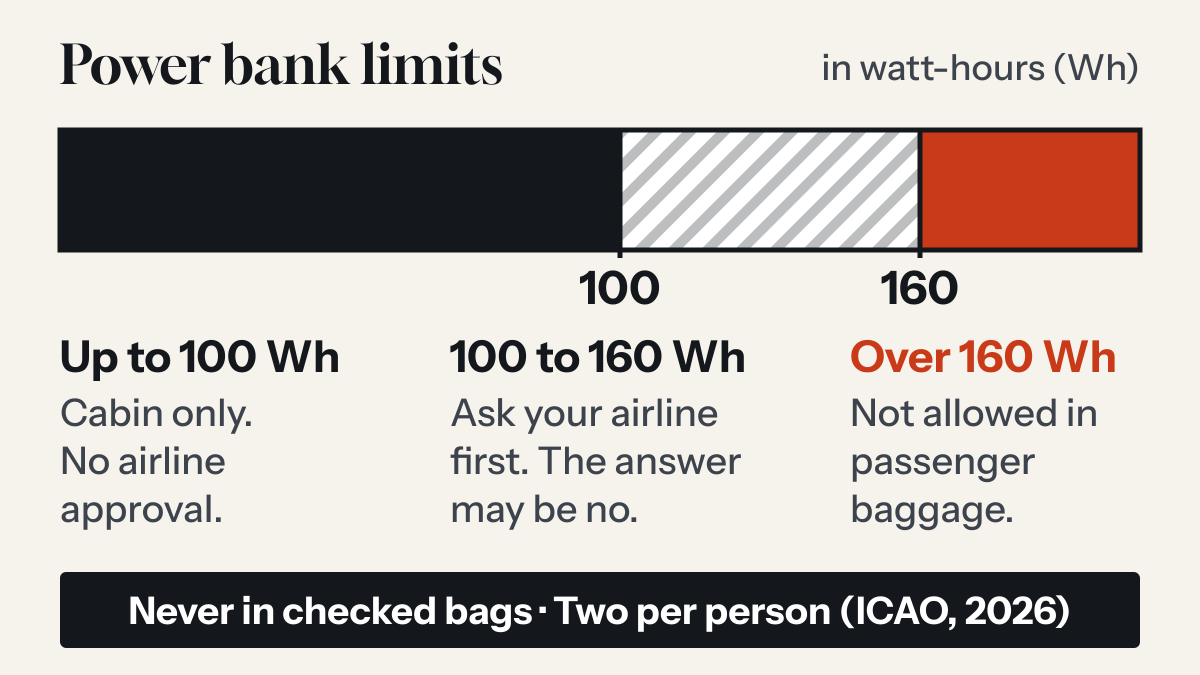
Limits are set in watt-hours (Wh), a measure of the energy a battery stores. The regulators agree on the lower and upper limits. They do not all say the same thing about the band in between.
| Rating | FAA and UK CAA | IATA passenger guidance |
|---|---|---|
| Up to 100 Wh | Cabin only, no approval needed | Cabin only, no approval needed |
| Over 100 Wh to 160 Wh | Cabin only, with the airline's approval | Listed as forbidden for power banks |
| Over 160 Wh | Not allowed in passenger baggage | Cargo rules only |
If your power bank is between 100 Wh and 160 Wh, treat that band as a question for your airline, in writing if you can, and allow for the answer being no. IATA's table lists these power banks as forbidden, while ICAO's addendum, the FAA and the UK CAA describe carriage with approval.
How to work out watt-hours
The FAA says newer lithium-ion batteries have the rating marked on them. If yours shows only milliamp-hours, the UK CAA gives the formula: voltage multiplied by mAh, divided by 1,000.
As a worked example, a pack marked 20,000 mAh at 3.7 V comes to 74 Wh, because 3.7 × 20,000 ÷ 1,000 = 74. Use the voltage printed on your own pack.
How to pack and carry it
- Keep it with youThe FAA says that if a carry-on is checked at the gate or planeside, power banks must come out of the bag and stay with you in the cabin.
- Protect the terminalsRetail packaging, tape over the terminals, a battery case or a snug plastic bag or pouch all count, according to the FAA.
- Keep it out of the overhead lockerIATA says power banks should not be stored there. The UK CAA says you may be asked to use the seat-back pocket.
- Do not top it up just before boardingIATA says airlines prefer power banks to be at less than 25%, and that a recently charged one should cool before you pack it.
- Leave damaged ones at homeThe UK CAA says batteries showing signs of damage, overheating or swelling should never be carried on an aircraft.
Using it on board
Recharging the power bank itself is out: the UK CAA's advice is not to charge your power bank on any flight. Using it to charge a phone is less absolute. ICAO's addendum says a power bank should not be used to recharge a device on board. IATA's guidance says it should not power other devices during taxi, take-off or landing. The UK CAA tells passengers to check first that their airline allows it and to keep the power bank easily accessible.
If a power bank or device gets hot, smokes or swells, tell the cabin crew straight away. Both the FAA and the UK CAA ask for this, and the FAA notes that flight crews are trained to respond to lithium battery fires in the cabin.
Flying in the United States
The TSA lists power banks as allowed in carry-on bags and not in checked bags, with the final decision resting with the officer at the checkpoint. The FAA's page, last updated on 11 August 2026, sets no general quantity limit for batteries up to 100 Wh as long as they are for your own use, but warns that many airlines have stricter limits on how many power banks each passenger can bring, whatever their rating.
Common questions
Can I put a power bank in checked luggage?
No. The FAA, TSA, UK CAA and ICAO's rules all require power banks to be carried in the cabin. If a carry-on bag is checked at the gate, take the power bank out and keep it with you.
How many power banks can I take on a plane?
ICAO's 2026 addendum sets a maximum of two per person, and the UK CAA applies that limit. The FAA page does not set a general number for batteries up to 100 Wh, but warns that many airlines have stricter limits, so check with your airline.
Can I use a power bank during a flight?
Do not recharge the power bank itself on board. ICAO's text says a power bank should not be used to recharge a device on board, and the UK CAA tells passengers to check first that their airline allows use on a flight.
Sources
- Changes Regarding Power Banks: Guidance Document for Operators, with ICAO Addendum No. 1 (draft text, Appendix C) IATA, 31 March 2026
- Passengers Travelling with Lithium Batteries: Guidance Document IATA, 31 March 2026
- Changes to rules on the carriage of lithium cells/batteries and power banks UK Civil Aviation Authority
- Pack right. Safe flight. UK Civil Aviation Authority
- PackSafe: Lithium Batteries Federal Aviation Administration
- What can I bring? Power banks Transportation Security Administration
Read next
Does fast charging damage your phone's battery?
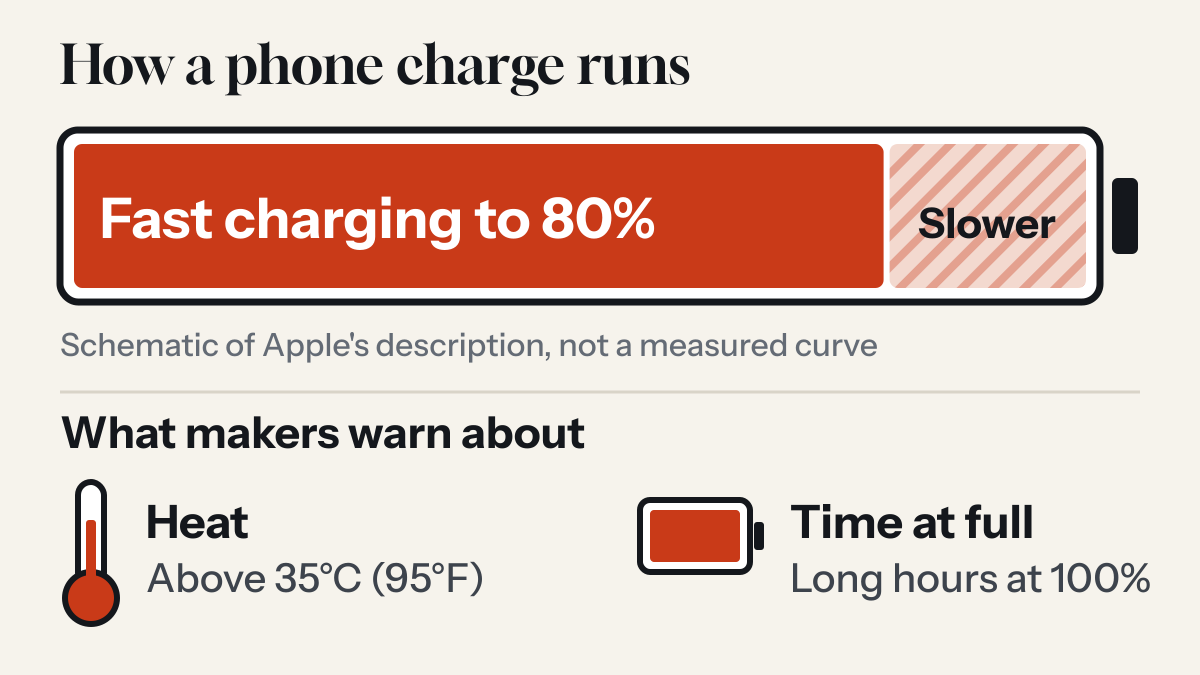
Every lithium-ion battery wears out. Phone makers build fast charging around that fact, and what they warn owners about is heat and long hours at full charge.
Are all USB-C cables the same? What the e-marker chip does
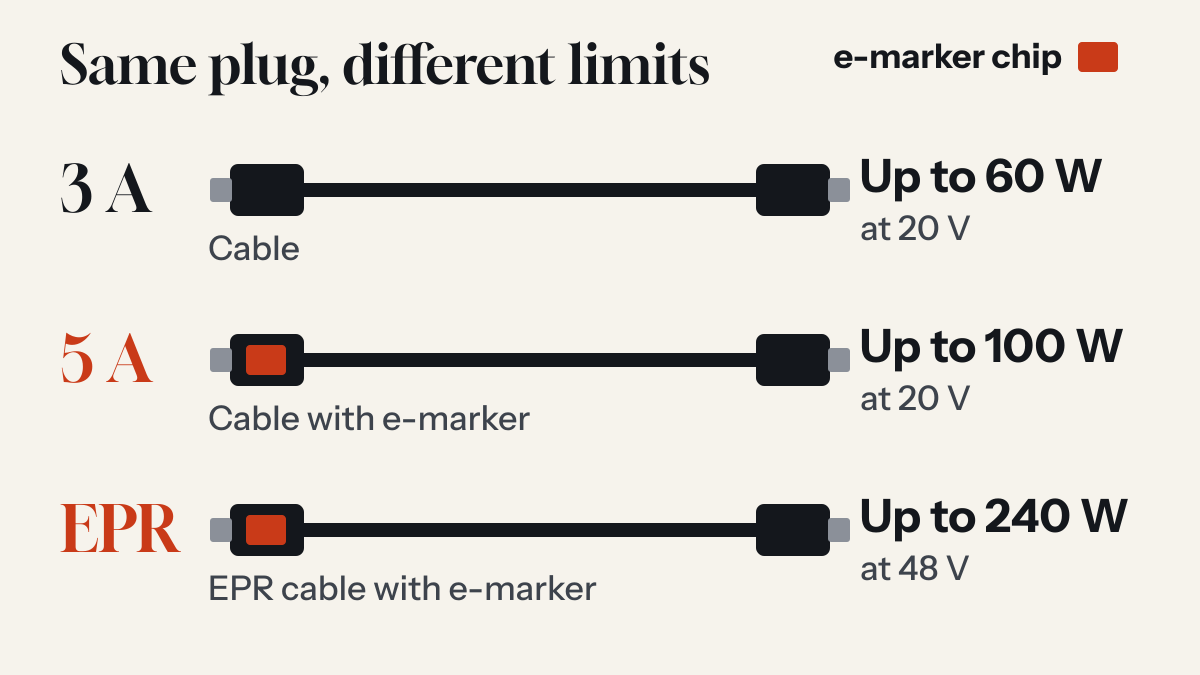
The plugs match. What the cable can carry does not, and some cables contain a small chip whose job is to say so.
How USB-C Power Delivery works: the short conversation before your phone charges
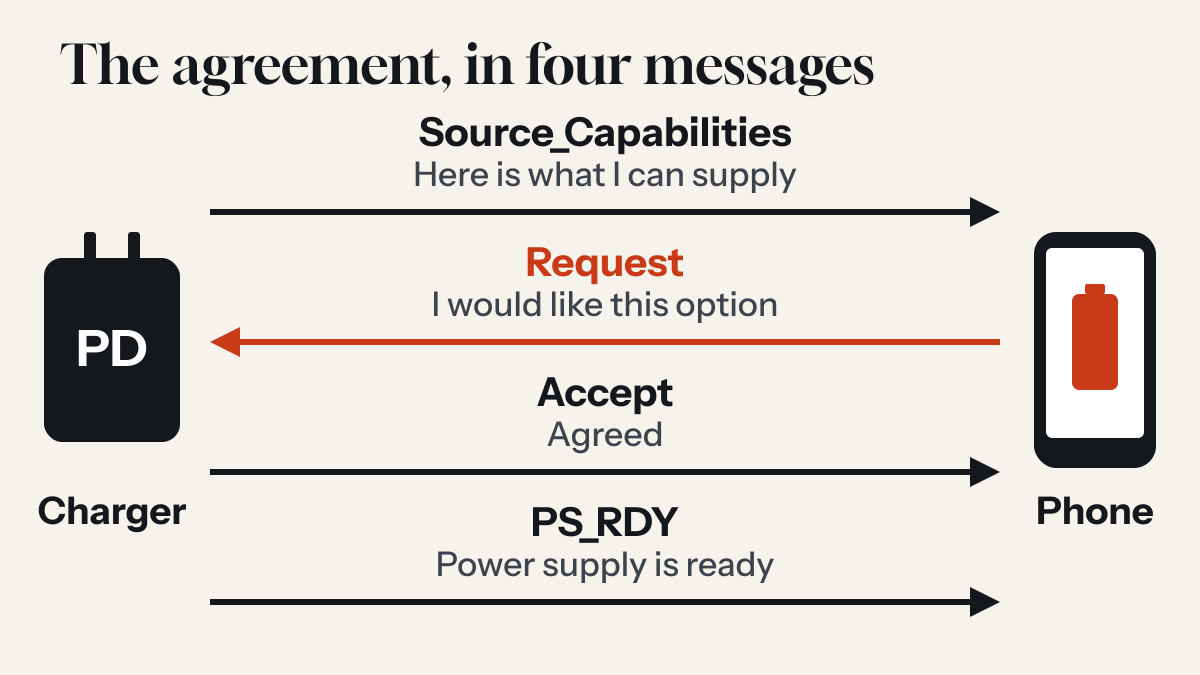
A USB-C PD charger does not simply push power at your phone. It lists what it can supply, the phone asks for what it wants, and only then does the voltage change.